
A Wretched Sinner
484 years ago, amongst the walls of the Tower of London, a young woman stepped out into the cold February air to mount a scaffold, but would only come back down again once she was dead.

‘Her execution was expected this week, for last night she was brought from the Syon to the Tower, but as she weeps, cries, and torments herself miserably, without ceasing, it is deferred for three or four days, to give her leisure to recover, and “penser au faict de sa conscience.”’
-Charles de Marillac
It was February 13th 1542, and Katheryn Howard had been held within the Tower walls for just short of 3 full days. She had been imprisoned within Syon Abbey beforehand, since the 11th November 1541.
Katheryn is a figure whom, whenever her execution date is mentioned, is treated somewhat like a criminal compared to those like Anne Boleyn and Lady Jane Grey. Due to the complicated circumstances of Katheryn’s downfall, historians through the ages have simplified it for the masses. She was guilty of adultery. She deserved to die.
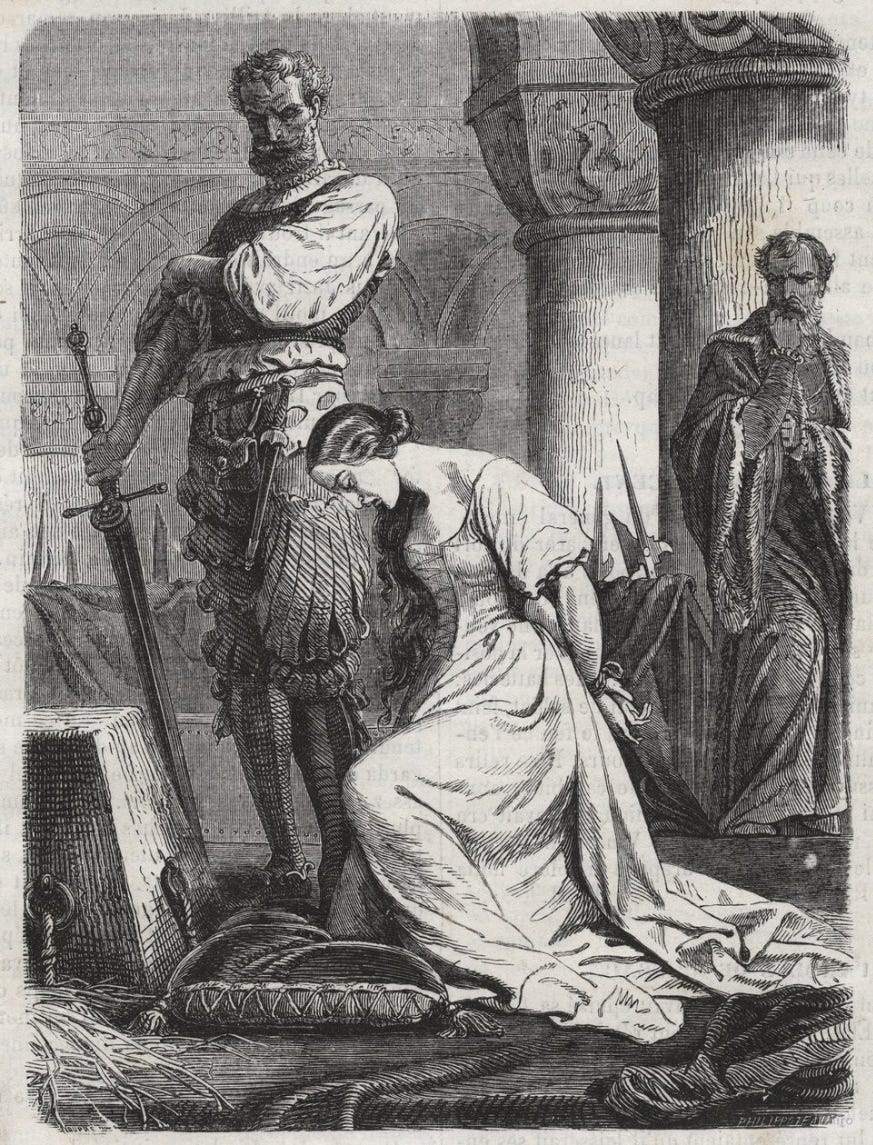
To simplify her case in this way is an injustice to the 19 year old who climbed the scaffold to her death and addressed a crowd of people who were there to feast on yet another display of Henry VIII’s ever increasing intensity of violence and cruelty.
In fact, contrary to popular belief, Katheryn was not executed for adultery.
She was convicted for concealing her past marital affairs before her marriage to the king (which, for context, was not even a law nor punishable when she married him. It only became a law one week before her execution date. That’s right, they had only just enacted this law so there was sufficient grounds to actually execute her).
But what about Culpeper?
Thomas Culpeper was executed in December 1541, and was the gentleman whom was accused of having an affair with the Queen. If they had not committed adultery, how was he executed?
During the investigation, Culpeper was interrogated.
He had confessed he 'intended and meant to do ill with the Queen and that likewise the Queen was so minded with him'. However, both he and Katheryn, ‘til their final breaths, were adamant that no adultery took place. The only physical contact between them was a kiss on the hand.
‘As she knelt and prayed with White, Catherine reiterated what she had done with Henry Manox and Francis Dereham, but ‘took God and His angels to be her witnesses, upon salvation of her soul, that she was guiltless of that act of defiling the sovereign’s bed’.
Even if there was not enough evidence to constitute treason for adultery, Culpeper’s admission that ‘he intended to do ill with the Queen’ was enough to constitute treason. Thinking, (or even perceived thinking in Katheryn’s case, as she never admitted any intent herself) was enough to get you killed in Henry VIII’s reign.
Historian Gareth Russell states:
‘…there’s this false assumption that what she did was treason. One of the most fascinating things I found out during research was the House of Lords and Parliament tried to stop the case against her because they were convinced that what she had done was not sufficient to constitute treason. […] That’s another thing I try to stress in the book, at every turn it’s his [Henry’s] hand pushing this case on, he wants revenge for her ‘humiliating’ him. It’s a wretched thing.’

And we return to the image of a 19 year old in front of a crowd, confessing ‘in few words that she had merited a hundred deaths for so offending the King who had so graciously treated her.’
I Die a Queen:
Along with the many inaccurate narratives around Katheryn’s execution, Katheryn proclaiming that she ‘dies a queen, but would rather die the wife of Culpeper’ is probably the most popular, and absurdly incorrect.
Due to Katheryn making no admission of any adultery taking place between herself and Culpeper, why would she make this proclamation in front of a crowd of people? And why is our only source for this nonsense written many years after her death?
If this was said, it would have been reported by ambassadors all over Europe. How scandalous that Queen Katheryn could make the king a cuckold in life and death!
But it was not. Charles de Marillac, French diplomat and ambassador, reported this of Katheryn’s death:
‘After writing the above, was informed that to-day, Monday, 13th inst., the condemned ladies should be executed; and, indeed, about nine o'clock in the morning, this Queen first, and afterwards the lady of Rochefort, within the Tower, had their heads cut off with an axe, after the manner of the country. The Queen was so weak that she could hardly speak, but confessed in few words that she had merited a hundred deaths for so offending the King who had so graciously treated her. The lady of Rochefort said as much in a long discourse of several faults which she had committed in her life.’
And Ottwell Johnson, a London-based merchant who actually witnessed the executions wrote:
‘I saw the Queen and the Lady Rochford suffer within the Tower, the day following, whose souls (I doubt not) be with God, for they made the most godly and Christians’ ends, that ever was heard of (I think) since the world’s creation; uttering their lively faith in the blood of Christ only, and with goodly words and steadfast countenances.’
There is no protestation of love mentioned. No mention of Culpeper. No mention of adultery. Just a young woman protesting she deserved death for offending the king, because let’s be honest, all she actually did was offend him and his ego.
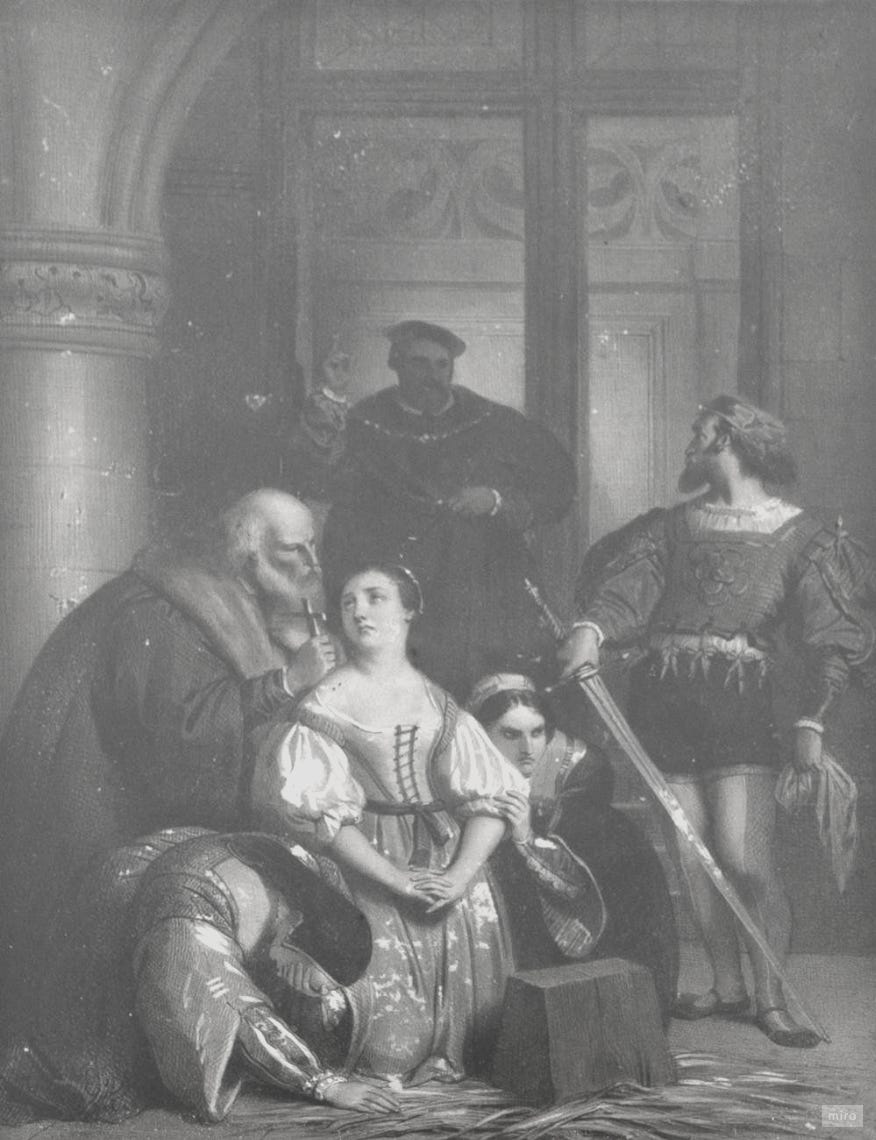
After her speech, she gave the executioner his fee and alms for the poor. Katheryn’s hood was removed and her hair was tied up under a white linen coif, leaving her neck bare. Katheryn took her last look upon the world, and was then blindfolded.
By Way of Experiment:
The night before, knowing she was to die the next morning, she had made the request to ‘practice’ with the block she would lay her head upon, ‘by way of experiment’. She did this over and over again.
Katheryn was incredibly well versed in the rigorous etiquette of the Tudor era. She was somewhat of a perfectionist, and was always commended for her politeness and her perfect behaviour in public. Some of this practice may have also been influenced by the botched executions of both Thomas Cromwell (which actually occurred on her wedding day in July 1540) and Lady Margaret Pole, Countess of Salisbury.
For Katheryn, this was an opportunity to ‘perfect’ the act of placing her head on the block to reduce the the event of a botched execution. Katheryn aimed to gain control in a situation that had no control; and just like the rest of her reign, to make no mistake in public.
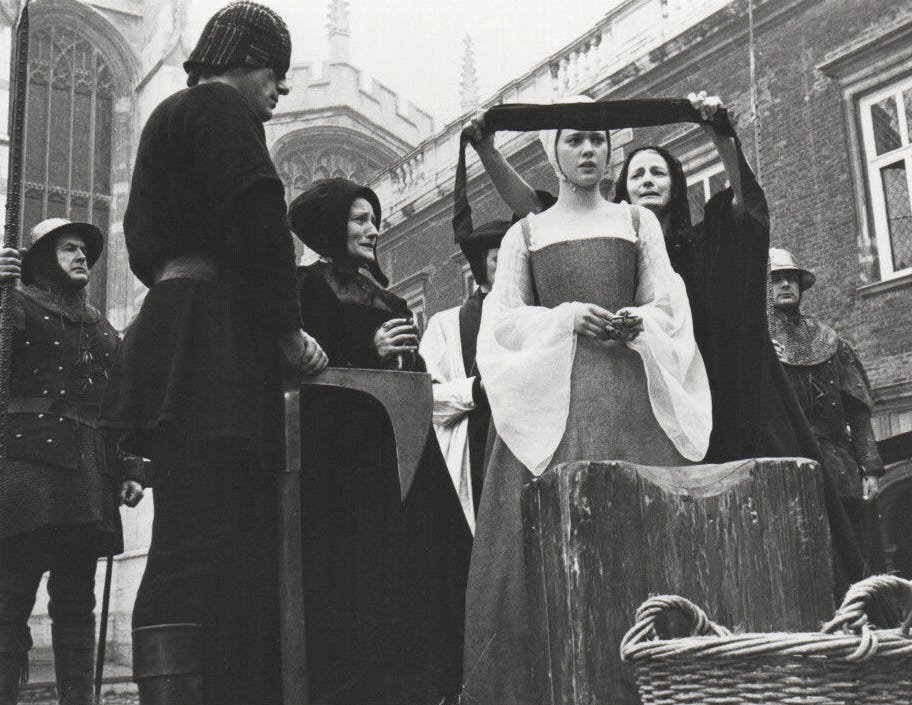
Just as she had practiced, she knelt and placed her head on the block. Her last few moments spent with bated, shallow breath, waiting for the moment the axe would fall.
‘She had made it familiar. She would leave with dignity.’
-Gareth Russell
With one rise and fall, one stroke, the life of Katheryn Howard ceased. She left with dignity and control in a situation where control was out of her grasp.
Her body was momentarily moved to the side while one of her ladies, Jane Rochford, was to suffer the same fate. She too was executed with one stroke of the axe.
They were both buried in the nearby chapel, the chapel of St-Peter-Ad-Vincula within the Tower walls, and the canons fired out of London. The final performance was over.
Today, there is a memorial plaque for Katheryn and her rough burial placement within the chapel. Her legacy is one usually dis-regarded, of little importance. Her person mutilated by inaccuracies and cruel assessments, even regarded as a prostitute by one popular historian, and an ‘airheaded wanton’ by another.
But to me, what a wonderful woman she was.
‘There was no time, there was no grace, there was no mercy for her to build a legacy. So if there is anything like a legacy, it’s the absence of it. It is a life stripped of a tomorrow for for one man’s rage.’
-Gareth Russell
Thank you so much for writing this because I fear I had fallen victim to the Katheryn Howard propaganda. She is the wife that I know least about out of the six and I have only heard the slanderous things about her: treason, adultery, etc. But this clears up so much; Henry was constantly changing the law to suit himself and inventing slander, an absolute mad lad.
Your writing style is also very pleasant to read and flows really well! And the last line: "But to me, what a wonderful woman she was." So beautiful! It was a pleasure to read of her last moments in the words of someone who holds such admiration for her! Great article!
peak substack